
Newsletter
|
Dec 5, 2025
A System Under Strain: The U.S. Navy faces China’s 2027 challenge, turning to drones, robotic fleets, and gamer-native operators worldwide
Copy Link

.webp)
Today we dive into the U.S. Navy's existential crisis: China is scheduled to surpass American naval power by 2027, and this race will determine whether the U.S. can defend Taiwan, protect global trade routes, and maintain its position as the world's dominant maritime force. You should pay attention because the Navy's plan to survive involves leveraging a gamer native generation to be drone operators and betting heavily on a fleet of robotic warships.
The United States Navy was born out of necessity on October 13, 1775, when the Continental Congress realized they needed a way to intercept British supply ships during the Revolutionary War. It started as a small, scrappy collection of converted merchant vessels, but after the war, the government disbanded the entire force to save money.
It was not until 1794, when American trading ships began to face constant attacks by pirates, that Congress passed the Naval Act to build a permanent fleet. Since those early days, the Navy has evolved from that handful of wooden ships into a global superpower, participating in 11 formally declared wars and dozens of other conflicts, ranging from the Quasi-War with France to modern operations in the Red Sea.
Over its 250-year history, the Navy has fought in hundreds of naval engagements, securing some of the most critical victories in military history. During the War of 1812, the USS Constitution earned the immortal nickname "Old Ironsides" when sailors watched British cannonballs literally bounce off its thick oak hull during a shocking victory against the HMS Guerriere.
A century later, the Navy fought the most significant naval battle in history during World War II at the Battle of Midway. In a decisive turning point for the war in the Pacific, American naval aviators sank four Japanese aircraft carriers, shifting the balance of power and cementing the U.S. Navy's status as the dominant force on the world's oceans.
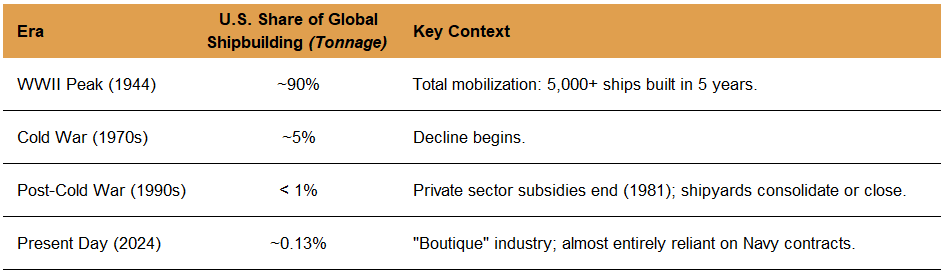
Following World War II, the United States possessed the most formidable industrial shipbuilding base in history, producing nearly 90% of global tonnage at its peak to support the war effort. Global tonnage is a measurement of the total carrying capacity or volume of all the ships being built or currently in use around the world. In just five years (1939–1945), American yards launched over 5,000 ships, including thousands of Liberty and Victory cargo vessels that kept Allied supply lines alive.
However, this dominance eroded steadily over the ensuing decades. By the 1970s, the U.S. share of the global commercial market had fallen to approximately 5%, though it still produced 15–25 large commercial ships annually. The industry's final collapse began in 1981, when the Reagan administration terminated "construction differential subsidies" (CDS) intended to offset the higher costs of U.S. labor and materials. Without this support, U.S. shipyards could not compete with heavily subsidized foreign competitors in Asia.
Today, the U.S. produces a meager 0.13% of global commercial tonnage, constructing fewer than 5–10 large ships a year.

Sources: Marine Insight, CSIS
True Value Rating (TvR) is a way of scoring navies based on quality rather than just quantity. TvR assigns a "power score" to each ship based on what it can actually do. A massive aircraft carrier represents a high power ranking, while a small patrol boat gets a low power ranking. For those familiar with the board game Axis & Allies, this system should be easy to understand. If you are not familiar, there is still time to order it to level up your holidays.
When you look at the raw numbers, China has already won the shipbuilding race, boasting hundreds more ships (if you include the Chinese Coast Guard) than the United States. The U.S. Navy is currently built like a heavyweight boxer: it has fewer ships, they are massive, high-tech giants—aircraft carriers and nuclear submarines—designed to travel across the entire planet and fight wars thousands of miles from home. That is why the U.S. still dominates in "tonnage," or total weight.
China, on the other hand, has pursued a different strategy, building a fleet like a swarm of bees. They have hundreds of smaller, faster ships (e.g. corvettes, missile boats, and Coast Guard cutters) that are perfect for controlling their own backyard—the waters around Taiwan and the South China Sea.
This disparity raises a critical question: Is the 'heavyweight' strategy still viable? While massive platforms like aircraft carriers remain essential for power projection, relying on them exposes a glaring industrial vulnerability. The U.S. has allowed its domestic shipbuilding capacity to atrophy, making the replacement of capital ships during a conflict nearly impossible.
The timeline contrast is stark: the United States constructed the USS Midway in just 17 months, commissioning it in 1945. Today, delivering a modern carrier takes nearly 8-10 years. To adapt to this new warfighting context, the U.S. must urgently integrate capabilities that are faster to produce and cheaper to deploy.
Current projections indicate a critical shift in the balance of naval power within this decade. While the U.S. Navy currently holds a slight edge in True Value Rating (TvR) (323.9 vs. 319.8) due to its superior carrier and submarine fleets, China's People’s Liberation Army Navy (PLAN) trajectory is much steeper. Based on current shipbuilding rates and modernization plans, many analysts predict China will surpass the U.S. in aggregate combat power (TvR) around 2027. This is driven by the commissioning of larger, more capable platforms. This gap is expected to increase in the 2030s.

Sources: CSIS, Military.com, Congressional Research Service
The chart above illustrates this trend. The "crossover point" represents a historic shift: for the first time since 1945, the United States would no longer be the world's dominant naval power by metric of pure combat value. This is not just about ship numbers; it reflects China's rapid fielding of naval assets that rival U.S. technological advantages. This 2027 date is also significant because, according to the U.S. Department of War, Xi Jinping has stated he wants to be ready to carry out the “reunification” plan with Taiwan by 2027.
How Does the U.S. Respond?
There are many efforts underway on how the US can respond to this critical shift in dominance. Each deserves its own newsletter as they are intricate, complex, and multifaceted. At a high level, here are 3 specific pillars to consider:
The Congressional Research Service report highlights that China’s massive shipbuilding capacity (over 200 times greater than the U.S. in some metrics) is driven by its commercial sector. The U.S. cannot sustain a wartime surge capacity relying solely on Navy contracts. The term “Dual-Use” has been used ad nauseam by the investment community over the past few years; however, it is necessary and an effort that has led this country to greatness and success time and time again.
A recurring theme in the shipbuilding industry is the shortage of skilled labor (welders, fitters, electricians). The "boom and bust" cycle of Navy procurement discourages long-term careers in trades. We need to continue to encourage and incentivize the reprioritization of necessary trades for our national interest.
The U.S. will pursue a shift toward a "more distributed fleet architecture" featuring unmanned vehicles (UVs). The U.S. cannot match China hull-for-hull in traditional warships. Swarms of armed drones and unmanned scouts can help close the numerical gap and complicate Chinese targeting. The U.S. will need more attributable systems and cannot just rely on expensive platforms, the war in Ukraine has demonstrated what a couple thousand dollar drones can do to much more expensive systems.
At Konvoy, from a new technology perspective, we are most interested in USVs (Unmanned Surface Vessels) and UUVs (Unmanned Underwater Vehicles).
Congress has made it clear: the Navy needs to move faster on unmanned systems, and they are putting $1 billion directly into the "Replicator" program to make it happen. This initiative is designed to field thousands of cheap, disposable drones by 2025 to counter China's massive fleet. The broader budget for unmanned systems has jumped to roughly $10 billion for 2025, a significant increase that underscores a shift toward robotic warfare.
This transition has revealed a surprising advantage: the "gamification" of war. As the Navy deploys these systems, it is discovering that the best operators are often not seasoned captains, but young sailors raised on Xbox and PlayStation. The skills honed in video games translate almost perfectly to piloting drones (multitasking, spatial awareness, and rapid decision-making on digital interfaces). Recognizing this, the Navy has begun replacing expensive, custom-made control sticks on submarines and drone consoles with off-the-shelf Xbox controllers, tapping into a workforce that is already "pre-trained" for 21st-century warfare.
The U.S. Navy is aggressively scaling its fleet of Unmanned Surface Vessels (USVs), often leveraging young sailors with a native gamer-centric talent pool to operate a tiered force. Large USVs (LUSVs) act as floating power stations to distribute energy and support extended operations, while Medium USVs (MUSVs) serve as persistent sensor nodes. At the smaller end, expendable scouts act as the fleet's "eyes," controlled remotely by operators who might be thousands of miles away, staring at screens that look remarkably like a strategy game.
Operational testbeds like Task Force 59 in the Middle East are proving that young operators can manage swarms of these drones intuitively, executing complex surveillance missions with an efficiency that traditional training cannot replicate. Congress has mandated accelerating these programs, pushing the Navy to field thousands of "attritable" systems by 2025 to overwhelm China's numerical advantage.
Beneath the water’s surface, the Unmanned Underwater Vehicles (UUVs) portfolio is transforming subsea dominance with platforms like the massive Orca XLUUV from Boeing and the agile Ghost Shark from Anduril. These robotic submarines, capable of autonomously laying mines and hunting enemy subs, are also benefiting from the "gamer interface" revolution. The complex task of navigating a 3D underwater environment is second nature to a generation accustomed to flight simulators and open-world games.
Congress, frustrated with delays in traditional shipbuilding, has directed the Navy to pivot toward these scalable, unmanned solutions. By combining $100 million in new funding for programs like the Orca with a workforce that intuitively understands digital command and control, the Navy aims to offset China's fleet size not just with better tech, but with a new kind of sailor—one whose training began in a living room rather than a boot camp.
As former Chief of Naval Operations Admiral Mike Gilday noted, the goal for the future fleet is to have intuitive technology, stating that by the end of the decade, "our Sailors must have a high degree of confidence and skill operating alongside proven unmanned platforms at sea."
Our Takeaway: The United States is throwing out the old playbook and building a completely new stack of offerings with a new type of gamer-centric sailor at the helm.
The U.S. Navy faces a critical deadline: China’s massive shipbuilding capacity means they are projected to surpass American naval power by 2027. Unable to match China hull-for-hull with traditional warships, the U.S. is pivoting to a "Hybrid Fleet" of thousands of cheap, unmanned surface and underwater vessels (USVs/UUVs), backed by $1 billion in new "Replicator" funding. A key advantage of this strategy is the "gamer generation"—young sailors whose video-game backgrounds make them naturally elite drone pilots. This reality is predicted in the novel Armada. We encourage you to read it. By leveraging intuitive controllers and virtual-game-like warfare, the Navy aims to offset China's industrial mass with a swarm of autonomous robots commanded by digitally-native talent.


.webp)

.webp)

.webp)
.webp)
.webp)
.webp)
.webp)
.webp)
.webp)
.webp)

.webp)
.webp)
.webp)

.webp)
.webp)
.webp)