
Newsletter
|
Feb 6, 2026
AI should change your workflows, not integrate into existing ones
Copy Link


There have been many mixed signals on how much large enterprises are adopting AI into their workflows in a meaningful way. Some argue that AI is already generating billions of dollars in productivity gains, while other surveys suggest there is a disconnect between what the C-suite thinks is happening and what is actually changing on the ground floor. We think the question of “are enterprises adopting AI”, is too broad of a question to be meaningful. The question is not “will AI take our jobs?”, but rather, “which jobs will AI transform and when?”
This week, we want to break down 3 specific questions:
What Are People Saying?
To start off, we wanted to aggregate some of the recent studies people are citing to understand where the confusion is coming from:
This is overwhelming, and everyone seems to be asking and answering slightly different questions. Here is a breakdown of the questions we find most interesting.
Are Enterprises Using AI?:
Right out of the gate, this is a loaded question that needs to be broken down further. There is a difference between using AI tools like ChatGPT and using enterprise tools that embed themselves into your tech stack and workflows. This is why questions from McKinsey like “Have you used AI in at least one business function?” are not helpful.
The recent MIT report does a much better job of distinguishing between these types of AI use. While there has been fairly broad adoption of general-purpose LLMs like ChatGPT, embedded AI systems rarely make it past the pilot phase.
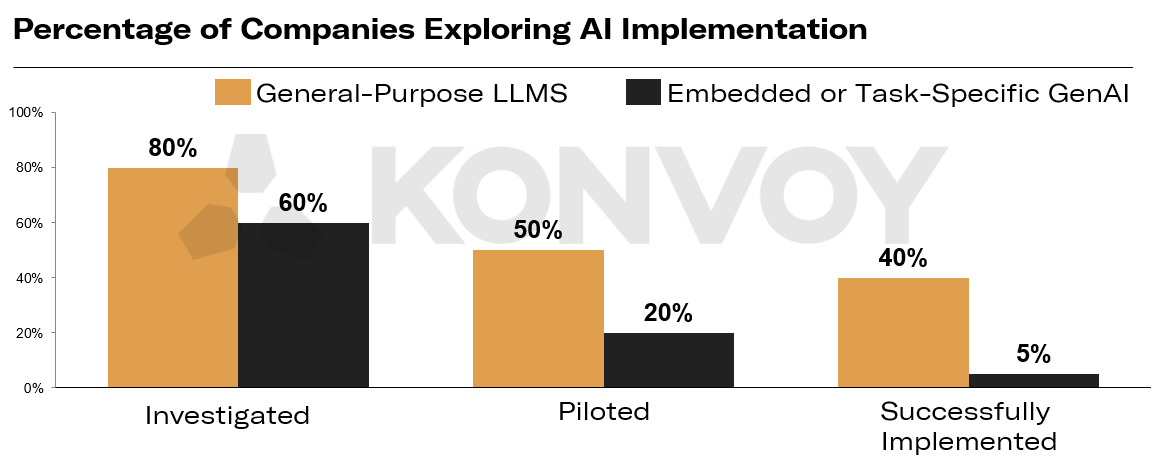
However, this does not capture the full picture either. Even though only 40% of companies report successfully implementing AI, 90% of employees report regularly using it for work tasks.
So are enterprises using AI? Most enterprises are not using deeply embedded AI, but they are using general-purpose LLMs whether they know it or not.
Which Enterprise AI Software Is Working?:
Now that we know that at least some of the embedded AI software is making it into production, we can ask, “what types are working?”
MIT provides a list of criteria for where AI pilots fail and why they struggle to integrate into key workflows. And Claude Code is a recent example of an embedded AI tool that solves each of these problems.
We are hearing and seeing Claude Code being implemented in a way that is radically changing workflows. Teams are running multiple agents at a time, and building products in days that used to take months. The success of Claude Code is multi-pronged:
While Claude has managed to radically transform some workflows, there have been varying degrees of success.
So, Who Is Claude Actually Working For?:
This question becomes more difficult to answer depending on what you mean by “working”. While it is easy to point to time savings or productivity gains, it is extremely difficult to measure them. Zapier argues that 91% of companies are struggling to measure AI’s true value.
Anecdotally, machine-readable infrastructure stands out as one of the largest differentiators between successfully adopting AI and having muted productivity gains.
For example, in some cases, Claude is unable to improve coding productivity because of the way it works with legacy systems. Out of the box, Claude can understand your code base in some capacity, but by improving your code base’s readability, you can see dramatically different results. Adding module-level context files to inform AI agents on key functionality and architectural decisions can dramatically improve their output. Additionally, refactoring the code (changing the way it is organized) can help the AI understand certain segments more easily without going beyond its context windows.
This idea is reinforced by McKinsey who highlights that the firms that have seen the best results from AI implementation are 2.8x more likely to redesign their workflows when implementing AI.
So the takeaway here is that enterprise AI success is less about model sophistication and more about organizational structure: legible systems, durable context, redesigned workflows, and the capacity to change.
What We Are Excited To See
As companies find ways to bolster brittle AI workflows, learn from their users, and layer in additional context, we expect AI to continue to proliferate through different parts of the enterprise. This can come in the form of a refactored code base, potentially adjusting internal workflows (to make them more AI-friendly), or in codifying business logic and management ideologies.
Takeaway: Enterprise AI adoption is fragmented. Broad, bottom-up usage of general-purpose AI is already ubiquitous, but AI that is deeply embedded into workflows is still nascent. Startups selling into large enterprises need to focus on quality (often enabled by using the correct context), and not just integrating into existing workflows, but learning from those workflows and creating a seamless and enjoyable user experience.


.webp)

.webp)

.webp)
.webp)
.webp)
.webp)
.webp)
.webp)
.webp)
.webp)

.webp)
.webp)
.webp)
.webp)
.webp)
.webp)