
Newsletter
|
Jan 9, 2026
AI continues to make progress reducing costs and changing gameplay
Copy Link

.webp)
Over the past few years, gaming has gone through two major hype cycles, from the metaverse to AI enabled games. The adoption of AI promised to have one-man studios generating AAA games from scratch, non-player characters (NPCs) that have natural conversations with players, and even whole worlds that could spawn in real-time, adapting and personalizing themselves to the individual user.
Now that the dust has begun to settle, we want to revisit some of these ideas, and look at where AI has made an impact, and what might still be around the corner.
Similar to other large software companies, we have consistently heard that AI is having the largest impact on cost savings and prototyping. Concept art, an initial pass at character dialogue, some coding, QA, and even certain 3D models have all been accelerated by the use of AI.
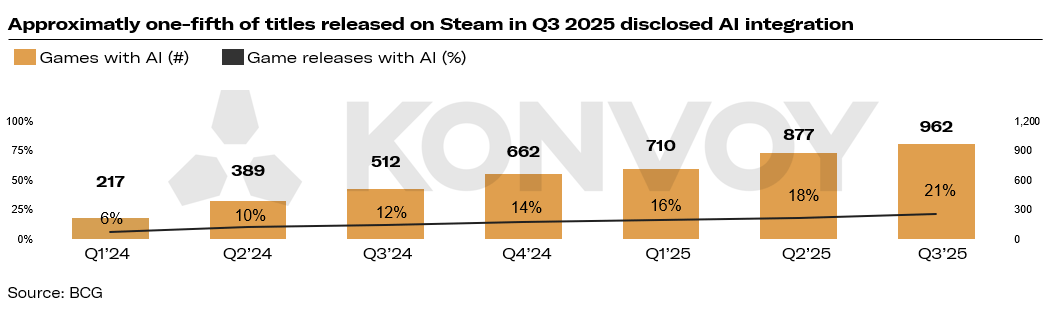
While this is still a far cry from a single prompt to a AAA game, it has still had a transformative impact on the gaming industry, and indie games may be seeing the largest benefits. As game funding gets harder and content volume keeps rising, rapid iteration at lower cost is essential for reducing burn and bringing a game to market. One example of this is Konvoy portfolio company VideoGame.ai, which has been able to ship multiple releases a week with a relatively small team. And they are not alone, 7,300 games on steam have disclosed AI integration into their development process, and in Q3’25 these accounted for 21% of all new games on Steam (BCG).
Second Order Effects: Interestingly, AI has made it easier and cheaper for indie developers to create games, but this has increased costs on the marketing and distribution side. As more games are released each year, getting noticed is increasingly difficult, and game discovery is a problem that the industry has been trying to solve for a long time.
It is not just indies that are benefiting from the cost-saving and prototyping efficiencies of AI — AAA studios are adopting this as well. Electronic Arts (EA) just recently announced they are partnering with Stability AI to focus on implementing AI to accelerate its workflows. The near-term focus will be on simulating real-world light behavior and pre-visualizing 3D environments. While these are not going to radically improve the game development process, it will certainly move the needle, and adoption from the largest players is an important signal to the rest of the industry, given the historical backlash that gamers have had to AI in the development process.
Acceptance outside of EA may not actually be the largest hurdle for AI adoption — we are hearing there is inertia within publishers as well. “Try out this new tool that might replace your job” is not the best pitch to drive adoption. This is especially true when the existing systems work. Activision, for example, was founded in 1979 and has been making games for almost 30 years. They have a system and tech stack that works, and allocating resources to implement new tools is likely not a top priority.
Even if AAA studios were able to implement these tools, there are a few major problems that still remain:
We have full faith that the industry will continue to work to solve these problems, but in the meantime, adoption will still be met with friction.
Konvoy has always looked at game development as the ultimate form of art. A beautiful amalgamation of code, art, and storytelling that, when delicately placed together, can create shared moments of joy, bursts of anger, or even pull on your heartstrings. The thought of introducing a black box AI and slapping on guardrails was a non-starter. These emotions are delicate, and gamers are unforgiving. An asset that feels out of place, or a line from your favorite NPC that seems a little off, pulls you out of the immersion.
Having said that, there are still some really fun experiences that would only be possible by implementing AI into games.
But this example is also helpful in understanding why it does not exist at the largest scale today. Baldur’s Gate took ~6 years to complete and was an enormous risk for the developer, Larian Studios. Introducing AI to just make better NPCs (especially when they already had incredible ones) was not worth the risk, especially in an ecosystem where fans are hostile to AI blips.
These risks are exacerbated by the complexities of actually implementing this technology. Latency concerns, inference costs, platform constraints, offline play, and safety all need to be addressed before a large-scale rollout.
Given these risks and limitations, we think this is another opportunity for indie developers to lead the charge. Lower budgets and leaner teams allow indie studios to take bold risks and implement emerging technology as a differentiator. In a world where it is harder and harder to be noticed, a unique implementation of AI could help catalyze a game to the top of the charts.
It is easy to highlight the risks of new technology, but to be clear, we are far more excited about the potential efficiency and experiences that AI will deliver to the gaming industry. A few of things we are keeping an eye out for:
Takeaway: Like any new technology, the industry's expectations were a bit further out than what the technology was capable of, but AI has already dramatically reshaped how games get made and will continue to do so. We have already seen cheaper, faster iteration across art, dialogue, code, and QA, especially for indies trying to ship faster in a tighter funding environment. While the technology will undoubtedly get better, there are both technical and psychological hurdles to overcome, and new problems to solve. We are excited to speak with the developers taking these problems head-on and continuing to drive innovation for the gaming industry and beyond.


.webp)

.webp)

.webp)
.webp)
.webp)
.webp)
.webp)
.webp)
.webp)
.webp)
.webp)
.webp)
.webp)
.webp)
.webp)
.webp)