
Newsletter
|
May 15, 2026
A new generation of aircraft is racing to make Mach 1+ travel routine both for passengers and warfighters.
Copy Link

.webp)
Today we dive into supersonics' two-decade dormancy and sudden revival: with NASA's X-59 completing its first flight in October 2025, Boom Supersonic's XB-1 demonstrator breaking the sound barrier in January 2025, the Trump administration lifting the 52-year overland ban in June 2025, and China and Russia openly fielding hypersonic missiles that the U.S. cannot reliably match.
This demands our attention because supersonics is the rare industry where commercial demand, defense urgency, and a generational technology reset are converging all at once.
Supersonic flight was born on October 14, 1947, when Chuck Yeager pushed the Bell X-1 past Mach 1 (the speed of sound) over Muroc Army Air Field. The aircraft was shaped like a .50-caliber bullet and dropped from the belly of a B-29 because no runway in the world could reliably launch it. Yeager flew with two cracked ribs from a horseback fall and a broomstick handle wedged in the cockpit so he could close the hatch. The result was a 700 mph dash that broke the "sound barrier".

The next two decades were a sprint. The F-100 Super Sabre became the first supersonic fighter in operational service in 1954. The North American X-15 hit Mach 6.7 in 1967, a manned crewed-powered-aircraft speed record that still stands. The SR-71 Blackbird entered service in 1966 and cruised at Mach 3.2+ on the edge of space, outrunning every missile fired at it across 24 years of operations.
Then came the civilian dream. The Anglo-French Concorde first flew in 1969 and entered passenger service in 1976, cruising at Mach 2.04 and crossing the Atlantic in under 3.5 hours. The Soviet Tu-144 beat it into the air by two months but proved unreliable and was pulled from passenger service after only 55 commercial flights. Concorde itself, beautiful and uneconomic, flew for 27 years and was retired in 2003 after the Air France crash, post-9/11 demand collapse, and the simple math of burning 6,770 gallons of fuel per hour for 100 passengers (4x a Boeing 747). For two decades after, no civilian aircraft on Earth flew faster than sound.
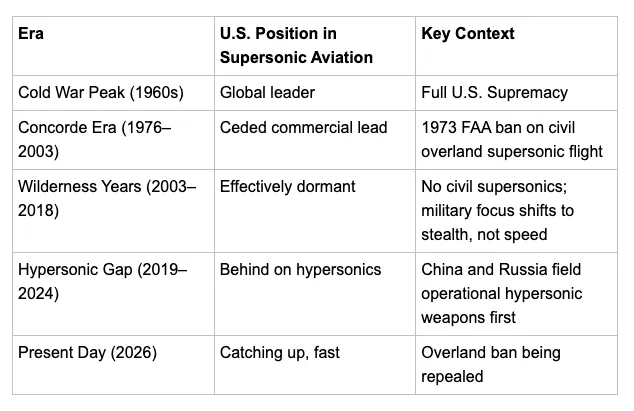
The U.S. effectively built the supersonic era and then walked away from it. Boeing's 2707 SST program was canceled in 1971 amid environmental concerns and ballooning costs, ending American commercial ambitions before they ever took off. Two years later, the FAA banned civil supersonic flight over U.S. land, not the speed itself, but the sonic boom sound (which cannot be mitigated even at high altitudes). That single regulation, intended to stop window-rattling over Kansas, became a 50-year industrial freeze that pushed every serious commercial program offshore or into the grave. This changed in June 2025 when Trump issued an executive order directing the FAA to repeal it within 180 days.
The military kept building, but priorities shifted. The B-1 went subsonic in practice. The F-22 and F-35 are supersonic-capable but built for stealth, not sustained speed. The SR-71 was retired in 1998 with no direct replacement. By the time U.S. intelligence confirmed in 2018 that China and Russia were operationally fielding hypersonic glide vehicles, the U.S. had spent two decades optimizing for stealth rather than speed.
The 1973 FAA ban made the sonic boom the number one barrier to commercial supersonic flight in the US. Decades of low boom research led to NASA's X-59 (built with Lockheed Martin Skunk Works): a demonstrator aircraft designed to produce a 75 PLdB "thump" instead of a boom. It completed its first flight on October 28, 2025, and will eventually cruise at Mach 1.4 at 55,000 feet. This is the unlock for supersonic travel without the sonic boom.
On the commercial side, the leader is unambiguous: Boom Supersonic, based in Denver (shout out to our hometown Colorado heroes). Its XB-1 demonstrator broke the sound barrier on January 28, 2025, the first independently developed civil aircraft ever to do so, and its full-size Overture airliner has 130 orders from United, American, and Japan Airlines. Overture targets Mach 1.7, 65 passengers, and a 2029 entry into service on 100% sustainable aviation fuel.
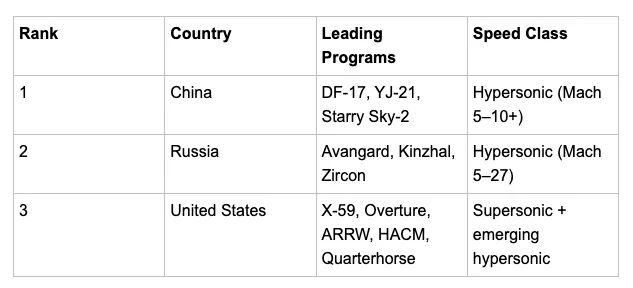
On the defense side, the leader on operational hardware today is China, with the DF-17 hypersonic glide vehicle now operational with the PLA Rocket Force and the anti-ship hypersonic missile deployed on destroyers. The U.S. response is in motion: Lockheed Martin (AGM-183 ARRW), Raytheon and Northrop Grumman (HACM), Hermeus (Quarterhorse, a reusable demonstrator pursuing Mach 5), and Anduril (working with the Air Force on autonomous high-speed systems). DARPA's HAWC program completed successful hypersonic cruise missile tests in 2022, validating the scramjet propulsion that underpins most of the next decade of Western programs.
The hypersonic gap is the supersonic equivalent of the U.S. Navy's shipbuilding problem: a generation of underinvestment created a window where adversaries built first, and the U.S. has to sprint to catch up. We are actively sprinting now. Russia used hypersonics in Ukraine starting in 2022, which was the first operational combat use of a hypersonic weapon recorded in history. China has paraded their hypersonic capabilities since 2019 and tested a fractional orbital hypersonic glide vehicle in 2021 that General Mark Milley called a near "Sputnik moment".
The U.S. has the propulsion science, the materials science, and the test infrastructure. What it lost was production cadence. The Pentagon's FY2025 hypersonic weapons request was $6.9 billion, with the FY2026 request at $3.9 billion as several programs transition from research funding into direct procurement funding.
The commercial gap is different but rhymes. While the U.S. was banning sonic booms, Europe built Concorde and Russia built the Tu-144. When the U.S. private sector finally re-entered the field around 2014 with Boom's founding, it had to rebuild a largely dismantled supplier base. Engine vendors were the hardest problem: Rolls-Royce walked away from Boom in 2022, and Boom has since partnered with Florida Turbine Technologies (a subsidiary of Kratos), GE Additive, and StandardAero to build the Symphony engine from scratch. There is no off-the-shelf supersonic engine certified for civil use anywhere in the world right now.
There are several converging efforts to close the supersonic and hypersonic gap. Each is worth its own deep dive, but at a high level, three pillars stand out:
1) Quiet the boom and rewrite the rules:
The X-59 program aims to provide the FAA with the data it needs to replace the 1973 overland ban with a noise-based standard. The June 2025 executive order has already set this in motion, directing the FAA to repeal 14 CFR 91.817 within 180 days and issue a Notice of Proposed Rulemaking on new noise certification standards within 18 months. NASA's community overflight tests with the X-59 will provide the empirical data underpinning whatever permanent standard emerges.
2) Rebuild the propulsion supply chain:
The U.S. cannot field supersonic or hypersonic systems at scale without a domestic engine industrial base. This means new entrants like Hermeus (turbine-based combined-cycle engines designed for Mach 0 to Mach 5+ in a single airframe), Boom's Symphony program (now acquiring dedicated test facilities outside Denver), and renewed investment in scramjet manufacturing at Aerojet Rocketdyne (now part of L3Harris).
3) Treat hypersonics as a portfolio, not a program:
The Pentagon has stopped trying to pick a single winning hypersonic system and is instead funding a portfolio of boost-glide, air-breathing scramjet, and reusable high-speed platforms. This mirrors the Navy's pivot to a distributed unmanned fleet. We need to accept that no single platform wins, and field many cheaper, faster-to-iterate systems instead of betting everything on one exquisite weapon.
Takeaway: The supersonic industry is in the same shape the U.S. Navy was a decade ago: a category the U.S. created, then quietly abandoned, then watched competitors operationalize. The difference is that supersonics is small enough and early enough in its second act that a focused industrial push can still win it.
The pieces are visible. Boom is the commercial flagship, with real orders, a flown demonstrator, and a 2029 entry-into-service target. Hermeus is the wildcard, betting that reusable hypersonics will define the 2030s the way reusable rockets defined the 2020s. Lockheed, Raytheon, Northrop, and Anduril are racing on the weapons side
The country leaderboard is China, then Russia, then sadly the U.S.; however, the U.S. is the only one with both a serious commercial program and a serious defense portfolio under development at the same time, and the only one whose private sector is producing breakthroughs at startup speed. The clock is the same; the runway is shorter than it looks.


.webp)

.webp)

.webp)
.webp)
.webp)
.webp)
.webp)
.webp)
.webp)
.webp)
.webp)
.webp)
.webp)
.webp)
.webp)
.webp)