Newsletter
|
Oct 16, 2026
Roblox struggles in the public markets and should be taken private
Copy Link


TL;DR: Roblox should be taking private because bookings is likely to rebound above 20% year-over-year growth and it would take little debt to make this transaction happen. At a $65 price per share, the base case returns 23.5% IRR to private equity, and the 6.5x exit multiple (EV/bookings) sits below the multiple the market paid for Roblox in 2023 and the 7.5x EV/bookings multiple paid for recently for EA ($55b). The exit plan is to relist the company in years back in the public markets, which is the same path that HCA, Kinder Morgan and Michael Dell took within about five years.
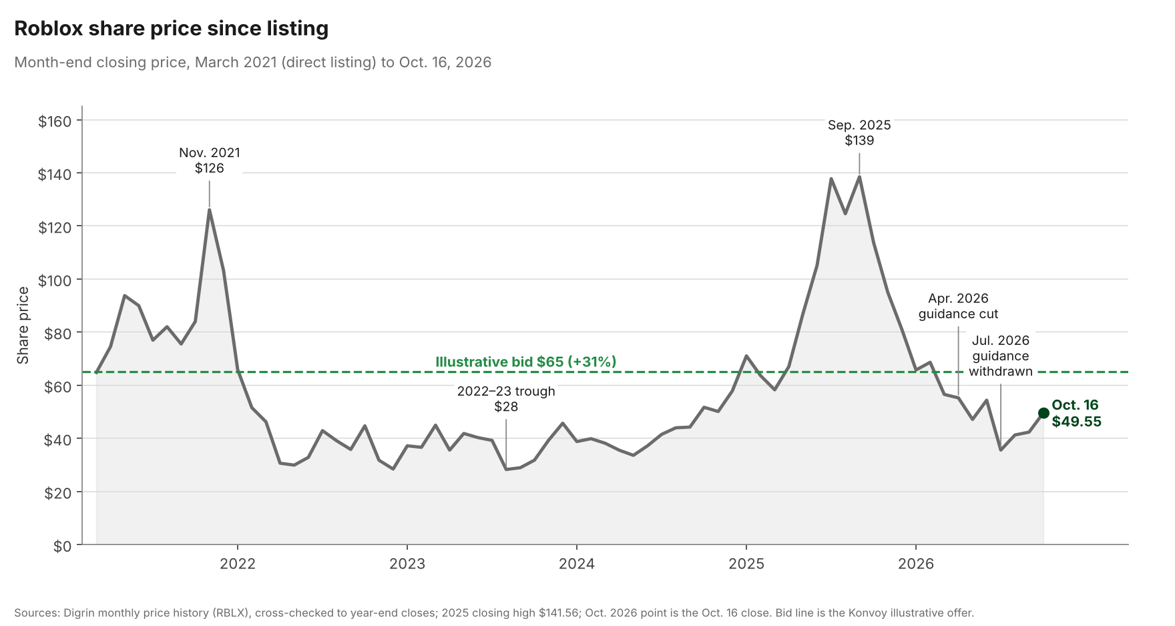
It is time to take Roblox private. They have struggled in the public markets, are investing for the long term, and we believe Roblox is best positioned to thrive as a private company for the next 5 years. They generate $1.35b in free cash flow, currently trade below every year-end multiple of bookings since it listed, and it is controlled by a founder (David Baszucki) who could heavily influence a take-private transaction that sets him up for immense financial success.
On October 16, Roblox closed at $49.55, a market value of $35b and 65% below its 2025 closing high of $141.56. In February of this year, management guided 2026 bookings to $8.3-$8.6b. In April it cut that to $7.3-$7.6b, and the stock fell 18% the next day. In July, it withdrew annual guidance and guided third-quarter bookings down 14%-18%. While they are scaling back their guidance of bookings (the main metric that the public markets value them by), they produced $1.35 billion of free cash flow in 2025 and hold $6.1 billion of cash and investments.
That combination of slowing growth, durable cash generation and a depressed price is a profile that makes Roblox a fit to take private.
We built an internal model for what this take-private transaction could look like and we believe there is a compelling case that the current price of Roblox (RBLX: $49.55) is within range. The core assumptions are: 5 year hold period, 20% annual bookings growth from a flat 2026, an exit relisting in the public markets at 6.5x enterprise value to bookings, and $5 billion of new debt alongside $4.5b of cash on their existing balance sheet.
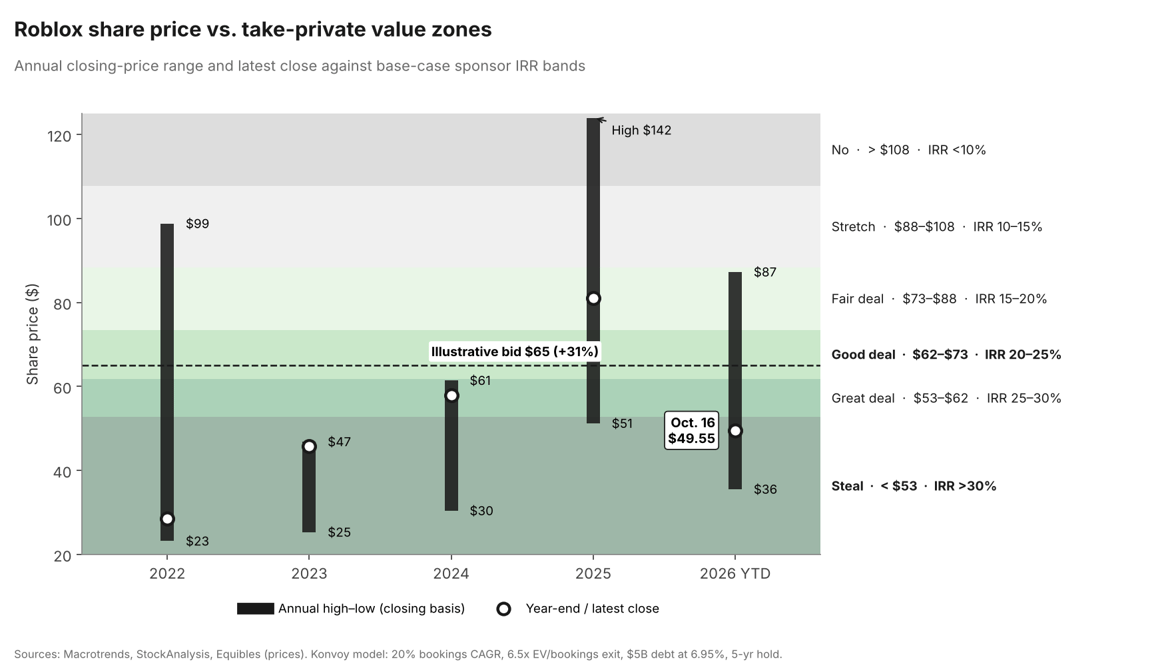
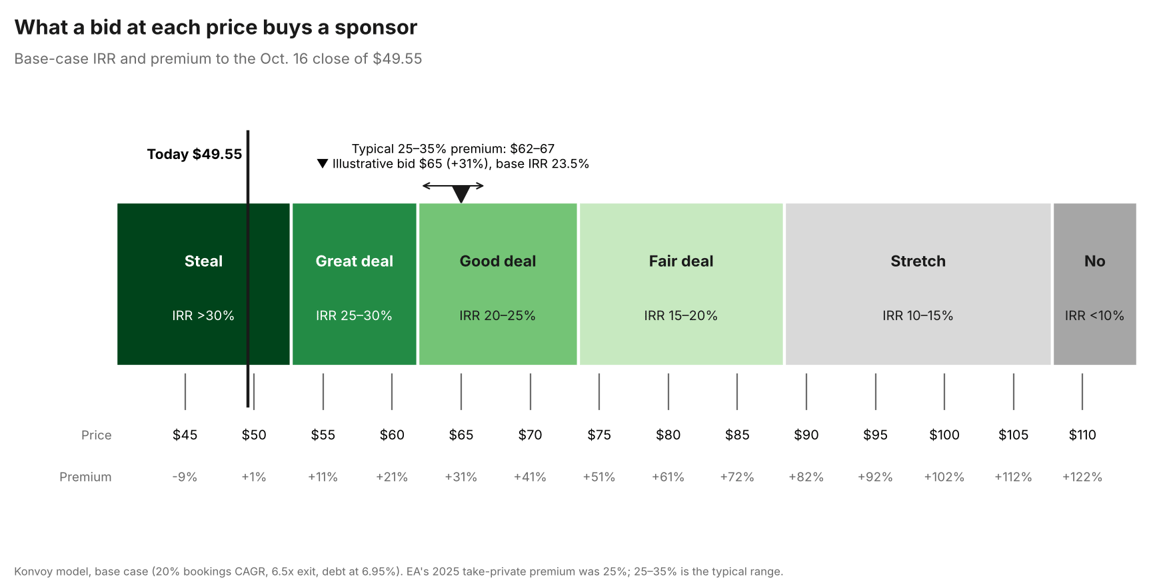
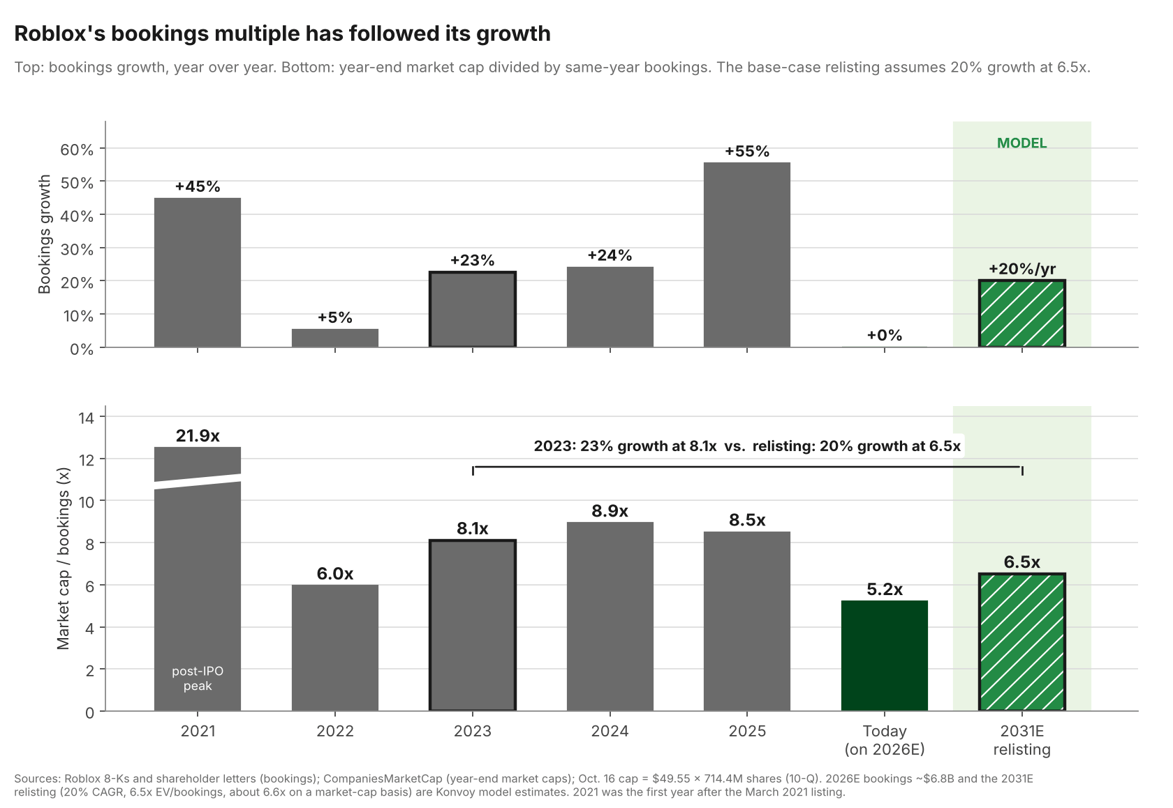
A buyer at today's price could earn a 32% base-case IRR. In private equity, it is more conventional for a take-private deal to offer a 25%-35% premium to the current stock price (EA's was 25%), so that would be closer to $62 to $67 a share. In this exercise, our illustrative bid of $65, a 31% premium to today’s closing price, returns a 23.5% IRR. The entry is near a cyclical low: the market values Roblox at 5.2x 2026 bookings, against 8.1x to 8.9x at the end of each year from 2023 through 2025.
1) Roblox is a key asset that is hard to replace, and its current strategy of investing for the long term is a poor fit for the public markets. Roblox has 123 million daily users and 27 million monthly paying users. They are targeting a market capture of 10% of the gaming market, yet this aggressive plan will require trading near-term gains for long-term retention of its entire audience (which now spans across Gen Z and Gen Alpha). This investment into R&D, tech, and safety is being critiqued by the market, which is why the stock is down so dramatically from last year. If they go private, they avoid this quarterly referendum and can focus on the 5 year plan.
2) Private capital can fund the levers that drive bookings growth (see below). Their second-quarter letter shows where growth is coming from: U.S. users over 18 years old grew 32% and monetized more than 50% higher than users under 18. Daily users grew 67% in Japan and 64% in India, and payers outside the U.S. and Canada grew 23%. These users need to be acquired, retained, and then monetized yet this happens over a longer period of time than one quarter. To achieve this, Roblox has to invest (a lot) through creator payouts, AI creation tools and advertising. In the private markets, a board can accept these near term investments with the long term value accrual in mind without being overly concerned with quarterly targets that have large impacts on the stock price.
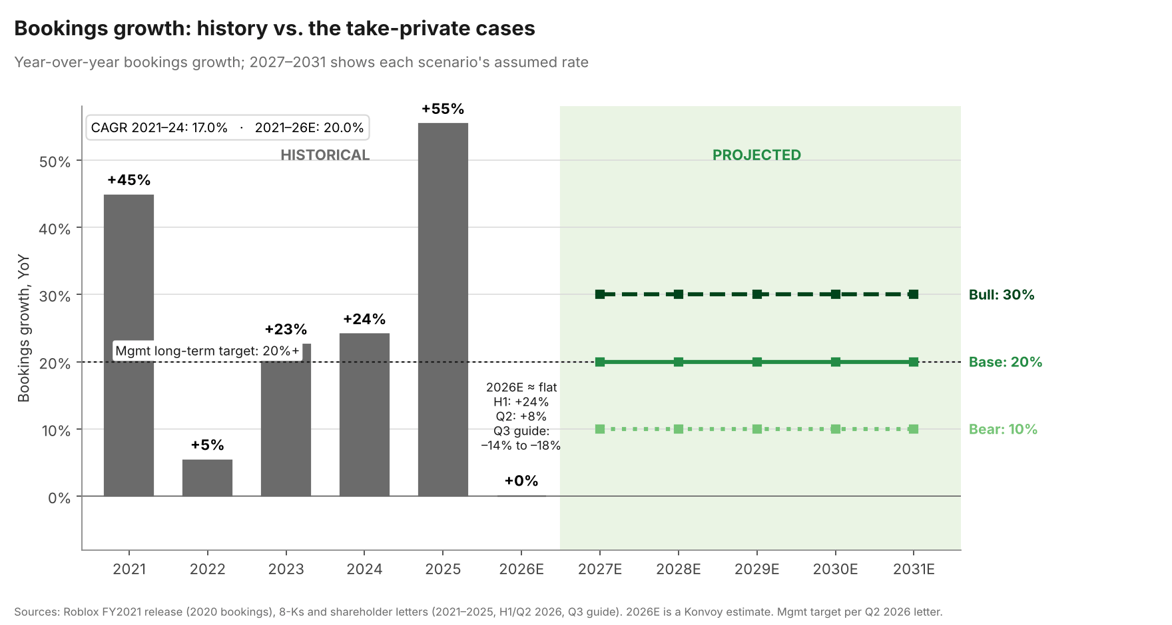
3) The public market has already paid more for this company’s growth (see below). Roblox's bookings multiple has tracked its growth. At the end of 2023 and 2024, with bookings growing 23% and 24%, the market valued the company at 8.1x and 8.9x bookings. Today, after a guidance cut and a forecast of flat 2026 bookings, it pays 5.2x. Our base case relists at 6.5x after five years of 20% growth, a lower multiple than the market paid in 2023 for similar growth. The return comes from compounding bookings, not from a richer multiple.
4) One shareholder decides. David Baszucki holds all 44.4 million Class B shares at 20 votes each, about 57% of the vote, and Roblox qualifies as a controlled company under NYSE rules. If he supports a deal, the shareholder vote is likely settled.
1) $36 billion in equity is larger than most PE funds. At $65 for a take-private price, sponsor equity is $35.9 billion. Recent flagship buyout funds range from $21.7 billion (Blackstone) to €26 billion (CVC), and concentration limits cap any one position at a fraction of that, so the deal needs four to six sponsors plus co-investment.
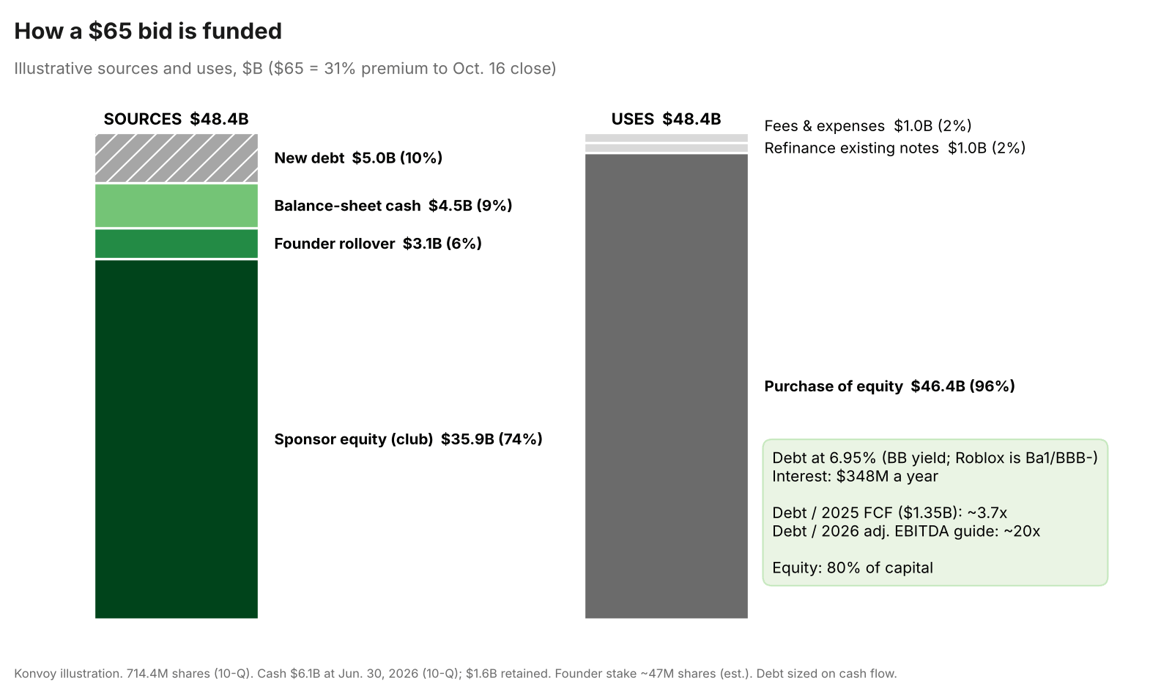
2) The capital structure is mostly equity. Roblox is rated Ba1 by Moody's and BBB- by S&P, and $5 billion of debt at the current BB yield of 6.95% costs $348 million a year. The debt is 3.7x free cash flow but about 20x the adjusted EBITDA Roblox guided for 2026, because bookings are collected before they become revenue. Lenders tend to focus on EBITDA, which is minimal for this company. Therefore this is not a typical LBO (leveraged buyout) transaction and 80% of the capital will need to be equity.
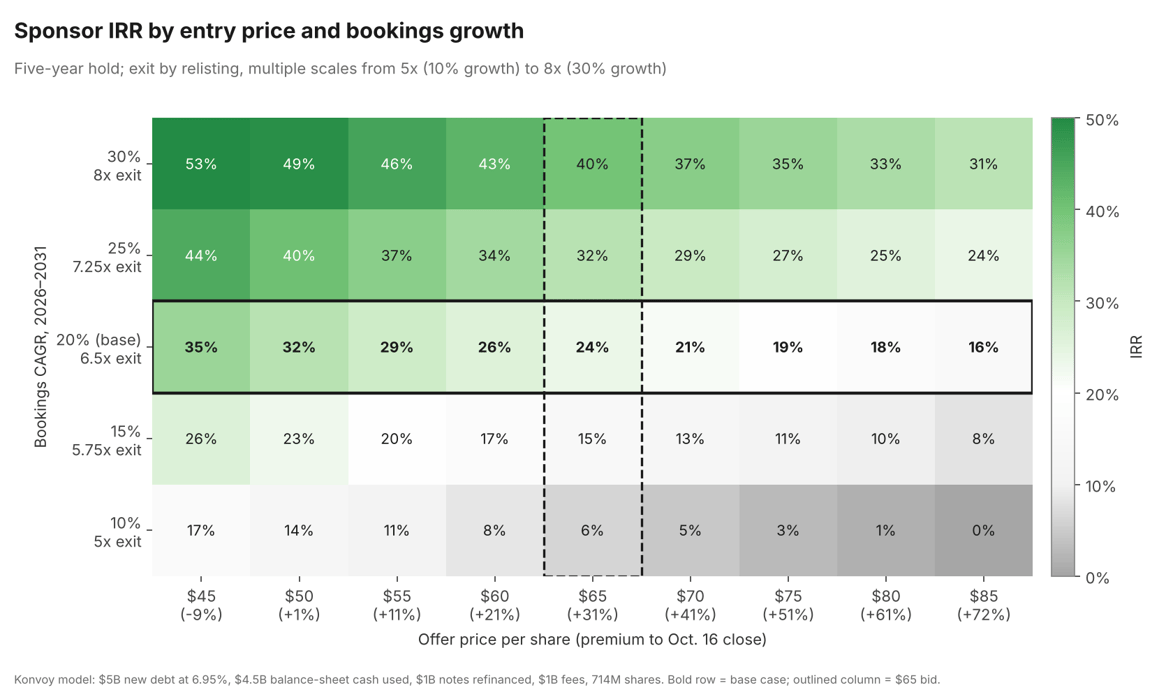
3) The return depends on a re-rating of the bookings multiple. If bookings compound at 20% but the market still pays today's 4.5x at exit, the base case returns 15% IRR at a $65 purchase price. The bear case, 10% growth and a 5x exit, returns 6.4% IRR (not great). With no growth for five years and a 4x exit, sponsors lose about 30% even with preferred protection. Additionally, child-safety litigation and concerns stay with the company even after it delists and some limited partners will not want a children's platform in their portfolios.
4) The founder already has control. Baszucki cannot be removed by public shareholders. The $3 billion buyback authorized in May shrinks the share count and raises his ownership without an external partner, the work of going private and relisting, or a preferred return hurdle. This complexity is a headwind to getting his vote, which is required.
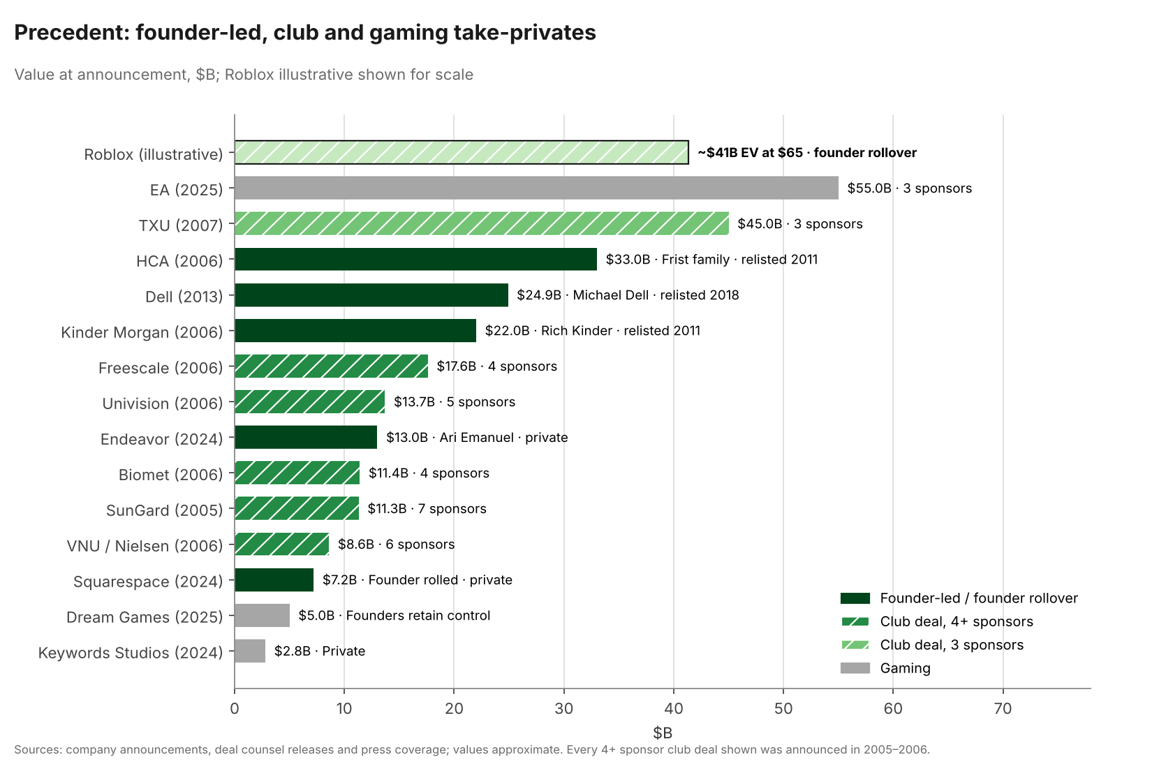
A founder-led consortium would bid for the Class A shares while Baszucki rolled his stake. The term “rolled his stake” means that Baszucki does not sell his shares when the company is bought. He swaps them for an equal value of shares in the new private company. At $65 a share, a 31% premium, the deal requires $48.4 billion: sponsors fund about three quarters, and Baszucki's rollover, $4.5 billion of Roblox's own cash and $5.0 billion of new debt cover the rest. Implied enterprise value is $41.4 billion, or 6.1x 2026E bookings.
A special committee of independent directors would negotiate with the consortium, Baszucki's vote would approve the merger, and the SEC would review a Schedule 13E-3 going-private filing alongside antitrust review. EA's $55 billion take-private took roughly ten months from announcement to close.
In case this note makes its way to the key decision maker, David Baszucki, here is the note we wanted to write to make the case for his personal incentive to take his company private:
Dave,
You have spent more than two decades building a place where 123 million people show up each day to play what other people made. This year, the market has judged that work one quarter at a time, which is not in line with your long term vision. You have chosen long-term retention among your youngest users over near-term spending, a decision we agree with, and the stock has fallen with each guidance revision.
We think you should consider spending the next five years of Roblox’s story in the private markets, where your long term strategy can play out without the quarterly noise. With 57% of the vote, this is ultimately your decision.
At $65 a share, your roughly 47 million shares are worth $3.1 billion, and you would roll all of it under one of two structures.
You would choose one, not both. In our modeled base case, Option A turns your current $3.1 billion in equity into $8.8 billion (2.9x) by 2031 and Option B into $19.0 billion (6.2x). In our bear case, 10% growth and a 5x exit, Option A protects you better but we believe Option B is where you’re actually headed as a company.
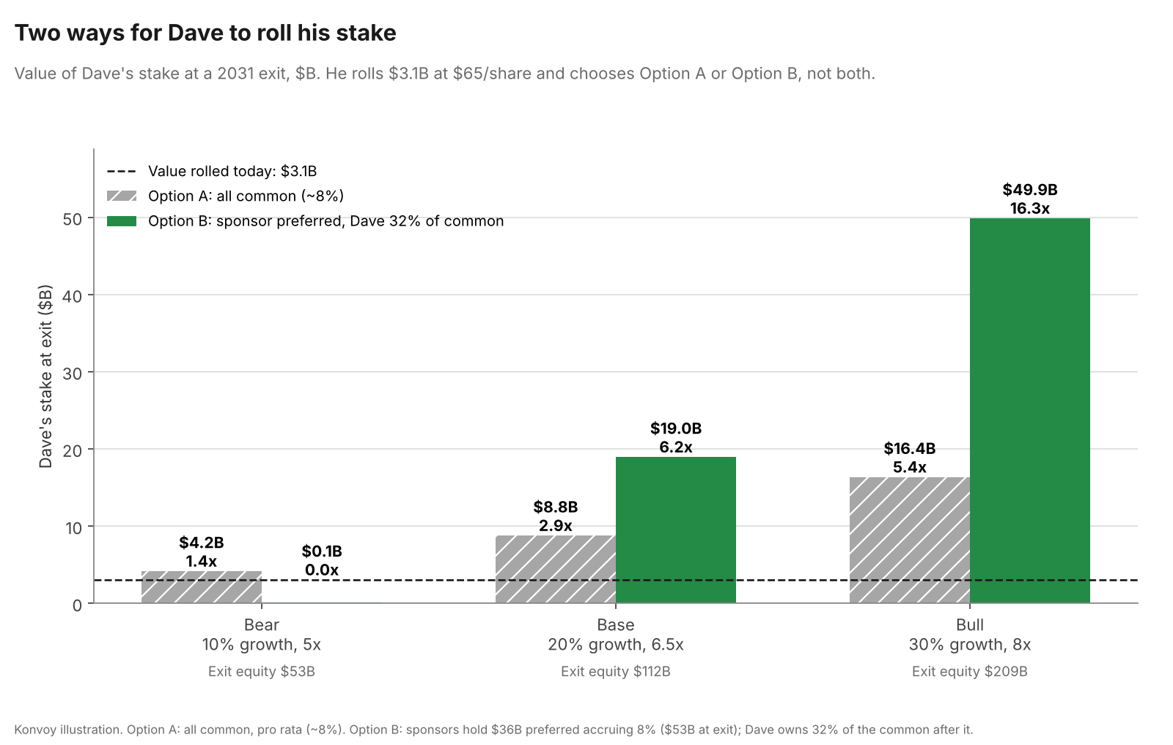
Option B pays more as long as:
What you would gain is time and less distraction: this would be five years to fund creators, adult users and new markets without the quarterly noise, a reset for employee equity granted at far higher prices, and the option to return to the public market on your terms, just as Michael Dell did in 2018. What you would give up is a public currency and the simplicity of a buyback you can run alone.
We believe that trade deserves consideration.
Thank you,
Konvoy
The underwriting comes down to bookings growth. The grid below maps the sponsor's return across entry prices and growth rates, with the exit multiple rising from 5x at 10% growth to 8x at 30%. At a $65 bid and 20% growth, the deal returns 23.5% IRR. Debt is 10% of the capital and interest is covered almost four times, so the outcome depends on bookings, not on leverage.
The historical precedents support both the size and the exit of this potential deal to take Roblox private. HCA, Kinder Morgan and Dell were each taken private alongside a founder and returned to the public market within about five years. Between 2005 and 2007, sponsors pooled capital for deals such as SunGard (seven firms) and VNU (six), until a Justice Department inquiry and a collusion suit that settled for $590 million ended the format. In gaming, EA's recent $55 billion buyout priced at 7.5x net bookings. At about $41 billion, Roblox would be the largest founder-led take-private on the list.
Takeaway: Roblox should be taking private because bookings is likely to rebound above 20% year-over-year growth and it would take little debt to make this transaction happen. At a $65 price per share, the base case returns 23.5% IRR to private equity, and the 6.5x exit multiple (EV/bookings) sits below the multiple the market paid for Roblox in 2023 and the 7.5x EV/bookings multiple paid for recently for EA ($55b). The exit plan is to relist the company in years back in the public markets, which is the same path that HCA, Kinder Morgan and Michael Dell took within about five years.