
Newsletter
|
Sep 4, 2026
How platform owners respond when someone else captures the value on top of their product
Copy Link

.webp)
The Aftermarket Premium
We have written before about the resurgence of physical products and about where value accrues as AI commoditizes production. This week we look at a company archetype that sits underneath both trends and has quietly produced some incredible businesses in cars, watches, and software: the aftermarket. Durable, high-end platforms generate a layer of businesses that modify them. That layer captures a disproportionate share of the end value, and the platform owner eventually has to decide whether to coexist with it, fight it, license it, or buy it.
In this piece we lay out the four ways platform owners can respond to aftermarket modifiers, walk through how each played out at AMG, Porsche, and Rolex, look at one physical category where the layer has not formed yet, and explain why software works differently.
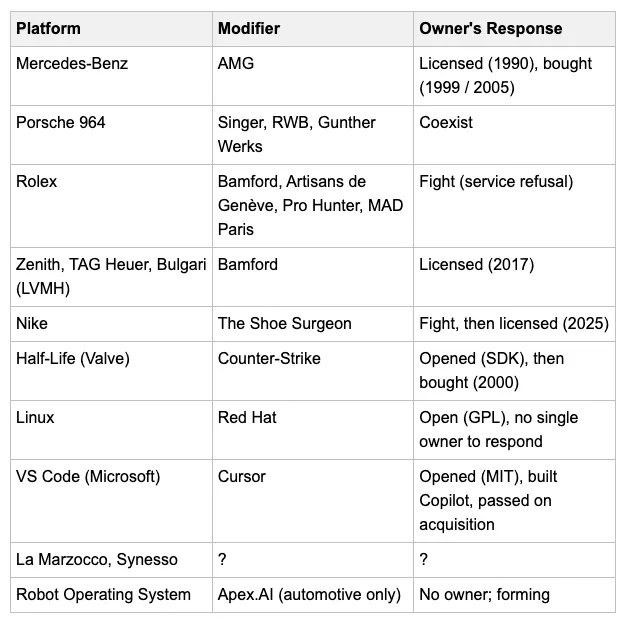
Platform owners typically have four options to deal with aftermarket modifiers:
Often, platforms deploy multiple strategies.

1986 AMG Hammer
In 1967, two Daimler engineers left the company after Mercedes wound down its motorsport program and set up AMG in an old mill in Burgstall, near Stuttgart. Rather than building vehicles, they modified existing Mercedes cars for private racing teams. In 1971, an AMG-modified 300 SEL 6.8 (nicknamed the "Red Pig") won its class and finished second overall at the 24 Hours of Spa against a field of much smaller cars.
Then, in 1986, AMG built the Hammer, a 190 mph sedan on the Mercedes W124 chassis and arguably the fastest sedan in the world. Then Mercedes (the platform owner) started responding:
Today Mercedes-AMG employs roughly 2,900 people and is responsible for the performance variant of nearly every model Mercedes sells. Notably, AMG still assembles each engine with a single technician who signs the finished unit (Mercedes-AMG).

Porche RWB Restomod
History is rhyming today with another high-end German auto manufacturer: Porsche. Singer Vehicle Design, founded in California in 2009, takes a customer-supplied Porsche 911 of the 964 generation (1989 to 1994) and rebuilds it over roughly 4,000 hours of labor. The original classic commissions ran around $600k to $650k, plus the donor car. The Carrera Coupe Reimagined, announced in May 2025, starts around $1.5m plus the donor and is capped at 100 units. A clean 964 donor averages around $90k, less than a tenth of the finished Carrera Coupe.
Singer is not affiliated with Porsche and is a restoration business, rather than a manufacturer. RWB in Japan and Gunther Werks in California are other well known restomod businesses with different aesthetics. While Singer delivers bespoke luxury mods, RWB has a raw punk widebody design, and Gunther Werks focuses on carbon-fiber track racers. Porsche, so far, has chosen to coexist with the layer without meddling, and it is hard to argue it has been the wrong call.

Les Artisans de Genève “Cool Hand Brooklyn” Rolex
Starting in the mid-2000s, George Bamford of Bamford Watch Department built a business blacking out new Rolexes with DLC and PVD coatings (diamond-like carbon and physical vapor deposition, thin-film treatments that turn stainless steel matte black). Other Rolex customizers include Pro Hunter, MAD Paris, and Titan Black. Rolex's response was to refuse after-sales service on any watch that had been altered. So Bamford had to build his own service department.
Then, in 2017, LVMH's head of watchmaking Jean-Claude Biver made Bamford the official personalization partner for Zenith, Bulgari, and TAG Heuer. Those watches now ship from the factory directly to Bamford's workshop with warranties intact. In exchange, Bamford agreed to stop customizing Rolex, Panerai, Omega, or any brand without an official partnership. Biver’s logic was that “people want more individualization. For a big company like us, we are more organized for standardization. So working with Bamford, we have the best of both.”
Not every modifier took the deal. Artisans de Genève stayed independent and now manufactures its own hands, bezels, dials, and cases for Rolex customization. Its Spike Lee Daytona (“Cool Hand Brooklyn”), for example, was a limited edition of 40 with roughly $40k of customization work per piece before the cost of the watch.
While basic instinct for platform owners may be to fight modding, it often does not suppress the layer. Rolex has refused to service modified watches for two decades and Artisans de Genève is still charging $40k apiece. What fighting does is cede the margin (and control) to someone else.

Café Leon Dore / La Marzocco Linea Micra collaboration (not an aftermarket modification)
One physical product category with every precondition for an aftermarket layer is high-end espresso machines. The global espresso machine market was around $3.5bn in 2022, growing at roughly 6% a year, and the commercial segment alone is around $1.2bn growing at 6.5%. Machines from La Marzocco, Synesso, and Slayer sell for $8k to $23.5k each. The owner community is obsessive, the machines last for decades, and service networks already exist.
While aftermarket modifications exist for entry level machines to improve performance (Gaggiuino on the Gaggia Classic for example), what is missing is a modifier whose own name carries a premium in the luxury segment. The pieces are obvious: pressure-profiling firmware and control boards, group head and paddle conversions, and designer casings and material swaps.
The Singer of espresso does not exist yet, and our expectation is that when it forms, La Marzocco (and the other OEMs) moves straight to the license option. Its brand has always been built on the barista community, and the Bamford watch precedent shows that a license deal is cheaper than a decade of refusing service.
There are a lot of examples of great aftermarket modding businesses for physical goods, but what about software? The physical aftermarket works because the platform owner cannot prevent it. Once a customer owns the 964, Porsche has no say in what Singer does to it. Software inverts this because a closed codebase and a license agreement mean no aftermarket can legally form; the platform owner decides in advance, by staying closed, open-sourcing the code, or shipping modding tools, whether one will exist. Every software example we can point to is a platform that chose to open up.
For example, in gaming, Valve shipped a software development kit with Half-Life, which enabled Counter-Strike to start as a mod in 1999. Valve then bought the rights and hired the team in 2000. Or in the operating system space: Linux is GPL open source, which is why Red Hat could build a $34bn support business on top of it. And more recently: VS Code is MIT-licensed, which is why Anysphere could fork it into Cursor in 2023. Microsoft’s response (as the VS Code platform owner) was to build Copilot into VS Code and, per CNBC, to examine an acquisition before ultimately passing. In June 2026, SpaceX agreed to acquire Anysphere for $60bn in stock, the largest acquisition of a venture-backed company on record, with Cursor at roughly $2.6bn in annualized revenue.
What software lacks compared to physical products is uniqueness. A fork is infinitely reproducible, so the value in a software aftermarket comes from the layer itself: support, gameplay, integration. That is a different business from Singer's, but it is still someone else's value built on the platform owner's asset.
Today, AI is collapsing the labor cost of software development, and with it the cost of modifying an already open platform. However, it does nothing to the legal barriers of closed platforms. The software aftermarket of the future will accelerate wherever open platforms exist, but nowhere else.
So where does the next software layer form? One candidate is the Robot Operating Systems (ROS). ROS 2 is Apache-licensed, its IP sits with the nonprofit Open Source Robotics Foundation rather than a for profit company, and it is the default stack for robotics R&D across drones, ground vehicles, and humanoids. The aftermarket has started to form in one segment: Apex.ai has hardened ROS 2 into a real-time and certified fork for automotive, backed by Volvo, Toyota, and Continental. But this is automotive only and nothing equivalent exists for industrial robotics, drones, or defense autonomy, where the same stack runs in production and the certification burden is just as intense. As AI drives down the cost of robotics software, our expectation is that the rest of the ROS aftermarket forms in the next few years, and that the eventual response is Buy, with autonomy companies and defense primes acquiring hardened ROS distributions the way IBM bought Red Hat.
Takeaway: The aftermarket is not a hobbyist niche; rather, it is a repeatable company playbook that produced AMG, Singer, Bamford, Counter-Strike, Red Hat, and Cursor. In physical goods, the layer forms over decades because modification is capital-intensive and owner communities are slow to build. In software it forms much faster, and AI is compressing that further. The software platform owner's real choice is made upfront: whether to be open or closed. For us at Konvoy, we are interested in builders operating on top of durable platforms with obsessive user bases and a nascent modifier ecosystem.


.webp)
.webp)
.webp)
.webp)
.webp)
.webp)
.webp)
.webp)
.webp)
.webp)
.webp)
.webp)
.webp)
.webp)
.webp)